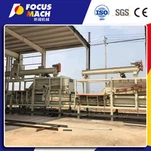
The plywood layup line is a core component in plywood manufacturing, responsible for glue application, veneer assembly (layup), and pre-pressing. It directly impacts the strength, flatness, and production efficiency of plywood. Below is a detailed breakdown of the layup line's key aspects.
Main Components of a Plywood Layup Line
(1) Veneer Feeding System
Function: Automatically or semi-automatically feeds cut veneers (face, core, back veneers) into the production line.
Types:
Roller Conveyor – For stable, continuous feeding.
Belt Conveyor – Suitable for delicate veneers.
Vacuum Lifter – Automated handling for high-speed production.
(2) Glue Spreader (Glue Applicator)
Function: Applies adhesive (e.g., UF, PF resin) evenly onto veneer surfaces.
Types:
Roll Coater: Best for high-viscosity glue; adjustable spread rate (typically 80-200 g/m²).
Curtain Coater: Provides uniform coating for low-viscosity adhesives.
Spray Coater: Saves glue but requires precise atomization control.
(3) Layup Station (Assembly Station)
Function: Stacks glued veneers into a plywood mat (e.g., face + core + back veneers).
Types:
Manual Layup: Used in small-scale production; flexible but slow.
Automatic Layup: Uses robotic arms or conveyor-based stacking (e.g., Homag systems).
(4) Pre-press (Cold/Hot Pre-pressing)
Function: Compresses the assembled veneers to ensure initial glue bonding before hot pressing.
Types:
Cold Pre-press: Hydraulic/pneumatic pressure (10-20 kg/cm², 1-3 min).
Hot Pre-press: Heated plates accelerate glue curing for faster production.
(5) Blank Conveyor & Stacking System
Function: Transfers pre-pressed panels to the hot press or temporary storage.
Common Systems:
Roller/chain conveyors
Automated stackers
Key Process Parameters
Glue Spread Rate
UF resin: 80-150 g/m²
PF resin: 100-200 g/m²
Uneven application leads to weak bonding or glue failure.
Balanced Layup Structure
Plywood must be symmetrical (e.g., 5-ply: face + core + center + core + back) to prevent warping.
Pre-pressing Pressure & Time
Cold press: 10-20 kg/cm²
Pre-press time: 1-5 min (depends on adhesive type).
3. Common Issues & Solutions
| Issue | Possible Cause | Solution |
|---|---|---|
| Poor Bonding | Insufficient glue, improper curing | Adjust glue spread, check adhesive quality |
| Misaligned Layers | Incorrect veneer positioning | Calibrate conveyor, add alignment guides |
| Delamination After Pre-press | Low pressure, short pressing time | Increase pressure or extend pre-press time |
| Excessive Glue Waste | Improper glue spreader settings | Optimize roller gap, switch to spray coating |
4. Automation Trends in Layup Lines
Smart Glue Application
Real-time glue monitoring (e.g., infrared sensors) for precise control.
Robotic Layup Systems
Vision-guided robots for high-precision stacking, reducing human error.
Digital Production Management
MES (Manufacturing Execution System) integration for process optimization.
Eco-Friendly Layup Technology
Low-formaldehyde (E0/E1) adhesives and reduced VOC emissions.
5. Maintenance & Safety Guidelines
✅ Routine Maintenance
Clean glue rollers to prevent clogging.
Check conveyor belt tension to avoid misalignment.
Lubricate hydraulic/pneumatic systems for smooth operation.
⚠️ Safety Measures
No open flames near glue applicators (adhesives are flammable).
Anti-slip flooring at layup stations to prevent accidents.
Safety light curtains on pre-press machines to avoid injuries.
Conclusion
The plywood layup line's efficiency depends on precise glue application, symmetrical assembly, and stable pre-pressing. Future advancements focus on smart automation, energy efficiency, and sustainable production.