Overview
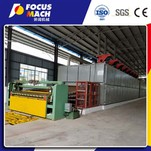
The plywood sanding machine is a core piece of equipment in the post-processing of engineered wood panels, primarily used for thickness calibration and fine polishing of plywood surfaces. It effectively eliminates surface imperfections such as unevenness, glue marks, and press marks, ensuring the required flatness and smoothness for subsequent finishing processes like laminating or coating. With the expanding applications of plywood, modern sanding machines are evolving toward higher precision, efficiency, and intelligent automation.
Working Principle
Plywood sanders operate on the grinding principle, where high-speed abrasive belts (or sanding rolls) create relative motion against the panel surface. The cutting action of abrasive grains removes microscopic surface irregularities, achieving refined surface finishing. The sanding process consists of three stages:
- Coarse Sanding: Uses 60-100 grit abrasive belts for rapid removal of major surface defects and thickness variations.
- Medium Sanding: Employs 120-180 grit belts to further level the surface.
- Fine Sanding: Utilizes 200+ grit belts to produce a smooth, refined finish.
Machine Structure & Components
1. Frame System:
- Constructed from high-strength cast iron or welded steel for operational stability.
- Equipped with precision linear guides to ensure sanding head movement accuracy.
2. Sanding System:
- Abrasive Belt Drive Unit: Comprising motor, drive roller, and tension roller.
- Contact Roller: Adjustable hardness rubber or steel roller.
- Pressure Grinding Mechanism: Pneumatic or hydraulically controlled pressure beam.
3. Feed System:
- Conveyor Belt: Variable-frequency drive (VFD) for adjustable feed speed.
- Feed Roller Assembly: Ensures stable panel transportation.
4. Dust Extraction System:
- Cyclone separator
- Baghouse dust collector
- High-pressure centrifugal fan
5. Control System:
- PLC (Programmable Logic Controller)
- HMI (Human-Machine Interface)
- Thickness monitoring feedback system
Key Technical Parameters
- Abrasive Belt Specs: Width 630-1350 mm, Length 2500-3500 mm
- Sanding Thickness Range: 0.3-60 mm
- Processing Accuracy: ±0.05 mm
- Feed Speed: 5-30 m/min
- Total Power Consumption: 30-150 kW
Applications
- Furniture Manufacturing: Cabinet and office furniture substrate preparation
- Architectural Decoration: Wall panel and flooring base material processing
- Packaging Industry: Export-grade crate board finishing
- Automotive & Marine: Interior panel pre-treatment
This detailed breakdown provides essential insights into plywood sanding machine technology, aiding in equipment selection, operation optimization, and maintenance planning for wood-based panel manufacturers.