Overview
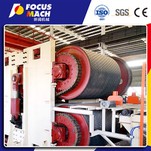
A Plywood Wide Belt Sanding Machine is a large-scale woodworking equipment used for calibrating, roughing, finishing, and polishing large panels such as plywood, particleboard, and MDF. Its key feature is the use of a continuous, wide (typically 1m to over 3m) abrasive belt to efficiently process entire panel surfaces with high quality.
Primary Purposes:
- Thickness Calibration: Eliminate surface variations and warping, ensuring uniform panel thickness.
- Surface Finishing: Remove glue residues, stains, pre-cured layers, and repair marks.
- Achieve Desired Smoothness: Provide a flat, smooth substrate for subsequent processes like laminating, printing, or painting.

Core Components & Working Principle
Key Components
- Frame: Robust steel structure ensures stability under high-speed, heavy-load operation.
- Feed & Exit Conveyors: Heavy-duty rubber belts or caterpillar tracks provide steady, powerful feeding, preventing slippage.
- Sanding Unit:
Contact Roller: Steel or hard rubber/polyurethane-coated roller for aggressive roughing and calibration.
Sanding Pad: Large, pneumatic or mechanically adjustable pressure pad for fine finishing, ensuring even pressure and
smooth surfaces.
- Abrasive Belt: Endless loop sanding belt with grits selected based on the processing stage.
- Drive System: Main motor (driving belts and conveyors), gearbox, and transmission shafts.
- Tensioning & Tracking System:
Tensioning Device: Automatically maintains optimal belt tension.
Tracking Device: Prevents belt drift, critical for safety and consistent operation.
- Dust Extraction: Powerful suction ports remove dust, maintaining cleanliness and preventing hazards.
- Control System: PLC and touchscreen interface for precise parameter setting (e.g., feed speed, sanding depth, pressure).
Working Principle
Panels are fed through the machine by the conveyor, passing under successive sanding heads (contact rollers or pads). The high-speed abrasive belt sands the surface under pressure, and finished panels exit via the output conveyor. The process is continuous and automated.
Types & Common Configurations
- By Number of Sanding Heads:
- Single-Head Sander: One sanding unit for basic applications.
- Dual-Side Sander: Most common for plywood. Simultaneously sands both surfaces, eliminating warping and ensuring parallelism.
Typical Setup: Coarse + Fine. First head (contact roller) for rough calibration, second (sanding pad) for fine finishing.
- Multi-Head Sander: Three or more units for complex processes (e.g., coarse + medium + fine; or bottom coarse + top coarse + bottom fine + top fine).
By Sanding Head Type:
- Contact Roller Unit: High stock removal for roughing.
- Sanding Pad Unit: High surface quality for finishing.
- Combination Unit: Integrates roller and pad for sequential roughing/finishing.
Key Performance Parameters
- Working Width: Max. panel width (e.g., 1300mm, 1650mm, 2200mm).
- Thickness Range: Min./max. panel thickness capacity.
- Abrasive Belt Size: Width and length.
- Main Motor Power: Determines sanding capacity and efficiency.
- Feed Speed: Adjustable; slower speed improves finish but reduces throughput.
- Sanding Depth: Typically 0.1mm–2.0mm per pass, depending on belt grit and power.
- Abrasive Grit Selection:
Roughing: 40#–80#
Intermediate: 100#–150#
Finishing: 180#–240# or higher
- Dust Extraction Airflow & Pressure: Must match equipment specs to ensure effectiveness and safety.