

This article focuses on the fundamental principles, core components, and different types of double-sided glue spreaders, providing an in-depth look at how they achieve uniform and efficient glue application.
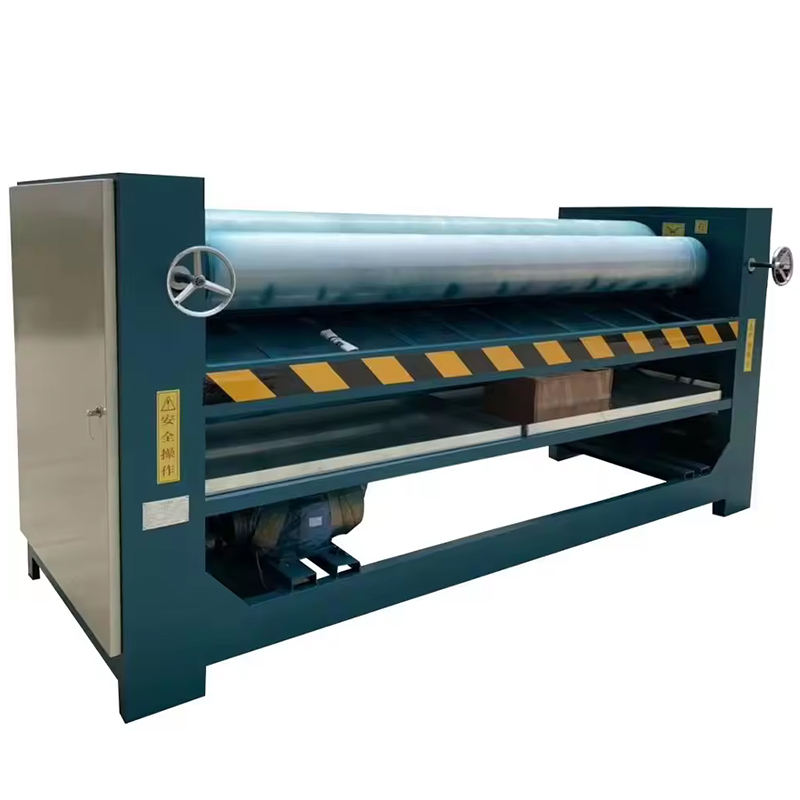
Core Function and Value in the Production Line
The primary function of a double-sided glue spreader is to apply adhesive evenly and quantitatively to both the top and bottom surfaces of a core veneer simultaneously. Compared to single-sided spreading, its core value lies in:
- Doubled Efficiency: It completes two-sided gluing in a single pass, resulting in very high production efficiency.
- Balanced Stress: Applying glue to both sides creates uniform tension, effectively reducing warping and deformation of the panel assembly and improving the flatness of the final product.
- Process Simplification: It directly prepares the panel for the layup process, making it an indispensable hub in automated, continuous production lines.
Its performance is directly measured by three key indicators: gluing uniformity, glue consumption control accuracy, and equipment stability.
Main Types and Drive Methods
Based on the arrangement and drive method of the spreading rollers, they are primarily categorized into the following two types:
Four-Roller Double Sides Glue Spreader:
- Structural Features: This is the most classic and common type. It consists of two metering rollers for transferring the adhesive and two spreading rollers that directly contact the panel. By adjusting the gaps and speed differences between these four rollers, precise control over the glue amount is achieved.
- Advantages: High application accuracy and uniform glue layer, especially suitable for low-viscosity adhesives (e.g., UF resin) and precise, thin gluing of calibrated particleboard or poplar core veneers.
- Drive Method: Modern models typically use independently driven servo motors for each roller, allowing for extremely precise control. Changing specifications can be done directly via the HMI without changing gears.
Two-Roller Double Sides Glue Spreader:
- Structural Features: This type has a relatively simpler structure, using only upper and lower two spreading rollers to apply the glue. It usually works with a glue tray or a doctor blade system to control the amount.
- Advantages: Compact structure, easier maintenance, lower cost, and greater adaptability to variations in panel thickness.
- Application Scenario: More suitable for higher viscosity adhesives (e.g., PVA) or situations where the requirement for application precision is less stringent.
In-Depth Analysis of Core Structural Components
A high-precision four-roller spreader consists of the following core systems:
Roller System: The heart of the machine.
- Material: Typically made from high-hardness, high-wear-resistance alloy steel or high-quality stainless steel. The surface is precision ground and chrome-plated to ensure smoothness, wear resistance, and corrosion resistance.
- Crown Design: To compensate for bending under pressure, precision spreading rollers are often machined with a slight convex profile (known as crown) to ensure uniform linear contact across the entire width when under pressure.
Gap Adjustment System:
- Metering Gap: The gap between the two metering rollers, which determines the thickness of the adhesive film transferred to the spreading rollers. This is the primary adjustment for glue amount.
- Spreading Gap: The gap between the spreading roller and the metering roller, used for fine-tuning the final glue application.
- Adjustment Mechanism: Modern equipment uses servo motor-driven worm gear mechanisms for digital, synchronous, and precise gap adjustment, with accuracy up to hundredths of a millimeter.
Transmission System: This has evolved from traditional gearbox collective drives to multiple independent servo motors. This not only simplifies the mechanical structure but also allows precise control of the speed ratio between rollers via electronic gearing, which is the technical basis for achieving different gluing effects (e.g., squeezing, scraping).
Glue Circulation System: Includes the glue pump, tank, piping, and return tray. A well-designed system ensures continuous and stable adhesive supply and includes self-cleaning and filtration capabilities.
Key Factors Determining Gluing Quality
- Roller Speed and Speed Ratio: The speed ratio between the spreading roller and the feed roller affects the coating effect on the panel surface. The speed ratio between the spreading roller and the metering roller determines whether the adhesive layer is "scraped thin" or "laid thick."
- Adhesive Properties: The viscosity, solid content, and temperature stability of the adhesive are crucial. Equipment parameters must be set precisely based on the adhesive's characteristics before production.
- Panel Condition: The flatness, thickness uniformity, and surface roughness of the core veneer directly affect the uniformity of the glue layer. For surface-porous, calibrated particleboard, it is often necessary to appropriately increase the amount of glue applied.


