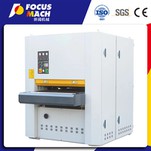
In the automated plywood production line, the process of assembling glued veneers into a "mat" (uncooked plywood stack) is critical. The Automatic Veneer Stacker (also known as an Automatic Layup Machine) is the key piece of equipment that automates this process, directly determining production efficiency and the quality of the raw panel.

1. Equipment Overview
The Automatic Veneer Stacker is a specialized machine designed to replace manual labor by automatically stacking glued veneers into a mat according to a preset number of layers and structure. It is positioned after the glue spreader and before the hot press or cold press, acting as a crucial "bridge" connecting these stages.
2. Core Components
A typical Automatic Veneer Stacker consists of the following key systems:
- Feeding System: Receives veneers from the previous process (e.g., the glue spreader), typically consisting of roller conveyors or belt conveyors.
- Vacuum Handling System: The heart of the machine. It comprises a vacuum pump, a set of suction cups, and lifting/lowering mechanisms. It generates vacuum pressure to firmly pick up each veneer and places it accurately via lifting and traversing motions.
- Mat Handling Carriage/Platform: Used to carry and transport the completed stack (mat). The carriage moves along rails to transfer the mat to the press.
- Alignment & Positioning Device: Ensures each veneer is stacked with edges aligned, preventing a skewed mat. This may include stoppers and pneumatic squaring devices.
- Electrical Control System: The "brain" of the machine. It typically uses a PLC (Programmable Logic Controller) and an HMI (Human-Machine Interface) touchscreen to set the layup scheme (e.g., total layers, face/back veneer settings) and control the sequence and coordination of all movements.
3. How It Works (Basic Principle)
The machine operates in a continuous cycle:
- A veneer is fed into the pick-up position by the conveyor.
- The vacuum head lowers, activates the suction cups to pick up the veneer.
- The head lifts, moves precisely over the stacking platform (or mat carriage).
- It lowers, releases the vacuum to place the veneer.
- The alignment mechanism ensures the veneer is positioned correctly.
- The process repeats for each layer until the mat is complete.
- The full mat is then transported to the press.