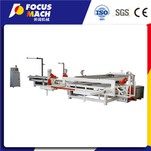
Plywood mechanical glue coating machine is a key equipment in plywood production. It is mainly used to evenly coat adhesives (such as urea-formaldehyde resin, phenolic resin, etc.) on the surface of veneer (wood veneer) to prepare for subsequent assembly and hot pressing processes. The following is a detailed introduction to this type of equipment:
---
1. Equipment classification
According to the gluing method and applicable scenarios, it is mainly divided into the following categories:
- Roller coating glue coating machine: The most common type, which transfers glue evenly to the surface of the veneer through rubber or steel rollers, suitable for glues with different viscosities and solid contents.
- Flow coating glue coating machine: The glue forms a continuous glue curtain through the curtain head, evenly covering the veneer, suitable for high-precision coating.
- Spray coating glue coating machine: It uses a high-pressure nozzle to atomize glue, which is suitable for irregular veneers or low glue coating requirements.
- Scraper coating glue coating machine: The thickness of the glue layer is controlled by a scraper, suitable for high-viscosity glue or special processes.
---
2. Core structure composition
- Glue roller: core component, mostly made of corrosion-resistant rubber or metal, with patterns on the surface to control the amount of glue.
- Glue tank: store adhesive, equipped with a stirrer to prevent precipitation.
- Measuring device: adjust the thickness of the glue layer (such as scraper, gap adjustment mechanism).
- Conveyor system: conveyor belt or roller to ensure that the veneer passes smoothly through the glue coating area.
- Cleaning device: automatically clean residual glue to avoid blockage.
- Control system: PLC or CNC panel to adjust parameters such as glue coating speed and thickness.
---
3. Key performance parameters
- Glue coating amount: usually 80~200 g/m² (adjusted according to the type of glue and process).
- Coating width: adapt to different veneer sizes (commonly 1.2~2.5 meters).
- Coating accuracy: error within ±5%
- Production efficiency: up to 20~60 m/min (continuous production line).
- Applicable glue types: water-based, solvent-based, formaldehyde-free glue, etc.
---
4. Technical features
- Uniformity: Ensure that there are no bubbles or leaks in the glue layer, which will affect the bonding strength.
- Energy-saving design: The glue recycling system reduces waste.
- Automation: It can be synchronized with the assembly machine and pre-pressing machine during online production.
- Adaptability: It can handle veneers of different thicknesses (0.5~5mm).
---
5. Application scenarios
- Plywood production line: Used for gluing core boards and surface boards.
- Blockboard/ecological board: Multi-layer wood bonding.
- Special board: Such as gluing of fireproof boards and ship boards.
---
6. Selection considerations
- Single board characteristics: thickness, surface roughness (affects the choice of glue coating method).
- Glue characteristics: viscosity, curing speed (such as phenolic glue requires high temperature resistant rollers).
- Production requirements: Match the speed of front-end and back-end equipment.
- Environmental requirements: Closed design reduces VOC emissions.
---
7. Maintenance and common problems
- Regular maintenance: Clean the roller and check the sealing of the glue groove.
- Troubleshooting: If the glue is unevenly coated, it may be due to roller wear or abnormal glue viscosity.
- Safe operation: Prevent glue from solidifying and clogging the pipeline.