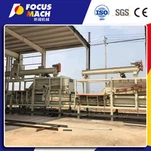
The particleboard production line is divided into chipping room, wood chip warehouse, shaving room, particleboard workshop, waste shed and thermal energy center. According to the production process, it is divided into particle production section, drying and sorting section, gluing section, paving and hot pressing section, rough board processing section and sanding and cutting section.
Small-diameter wood and branch wood are removed from the metal detector to remove metal. After chipping, they are sent to the coniferous or hardwood wood chip warehouse for storage according to the tree species; purchased wood chips are directly sent to the coniferous or hardwood wood chip warehouse.
Coniferous and hardwood wood chips are quantitatively matched and then sent to the wood chip screening machine for screening. The wood chips are removed from the production line as fuel for the thermal energy center; small-sized wood chips and conventional wood chips are stored in special wood chip warehouses respectively.
Small-sized wood chips are processed into qualified wood chips by high-speed ring chippers and stored in wet wood chip warehouses; conventional wood chips are processed into qualified wood chips by ordinary ring chippers and stored in wet wood chip warehouses. After screening, the purchased sawdust is sent to the wet sawdust bin for storage.
Drying and sorting section
Wet shavings and sawdust are continuously and evenly sent out by the discharging device of each storage bin, and enter the single-channel drum shaving dryer for drying via the scraper conveyor.
Dry shavings are transported to the dry shaving bin for storage via a mechanical conveyor, and then enter the shaving screening machine for screening. The wood powder removal production line is used as fuel for the thermal energy center. Fine shavings are sent to the surface dry shaving bin for storage, large shavings are sent to the air flow separator for sorting, qualified shavings are sent to the core dry shaving bin for storage, and oversized shavings are sent to the sieve ring grinder for grinding and then enter the screening machine for screening again.
In order to adapt to the changes in the proportion of surface and core shavings when producing finished boards of different thicknesses, a bypass screw conveyor is set to adjust the amount of shavings entering the sieve ring grinder.
Gluing section
After metering, the dry wood chips of the surface and core layers are continuously and evenly fed into the glue mixers of the surface and core layers. At the same time, the glue liquid of the surface and core layers and other additives that are automatically metered are respectively injected into the glue mixers of the surface and core layers according to the formulas formulated in the production process. In the glue mixer, the glue liquid is evenly wrapped on the surface of the wood chips through mutual friction, forming the surface and core layer glued wood chips.
Paving and hot pressing section
The glued wood chips of the surface and core layers are respectively fed into the metering bins of the corresponding surface and core layer paving machines through belt conveyors. The paving machines spread out continuous slab belts with three-layer composite structures on the continuously running slab conveyors.
After weighing, metal detection, moisture content detection and pre-pressing, the qualified slabs enter the continuous hot press, and the unqualified slabs are discharged into the waste slab recovery bin, and then sent to the wet shaving bin for reuse by the pneumatic conveying system. The slab conveyor is equipped with a slab humidification device.
Rough board processing section
After hot pressing, the continuous rough board strip is cooled by the cooling plate turning machine after bubbling detection, thickness detection, weight detection, edge cutting, and cutting, and then transported to the intermediate storage system for storage after stacking. The sawed edge waste is crushed and sent back to the wet shavings bin through the pneumatic conveying system for reuse.
Sanding and cutting section
The particleboard transported from the intermediate storage warehouse is sanded by a four-head fixed thickness sander and a four-head fine sander, and then graded, inspected and stacked; the independently set cutting center can saw the sanded particleboard into finished boards of specifications according to the width size required by the customer. The finished boards are packaged and shipped.