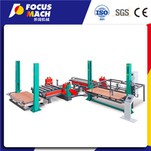
1. Equipment Overview & Working Principle
The 4-Feet Spindle Veneer Peeling Machine is a core piece of equipment in the production of wood-based panels, specifically designed to peel logs into continuous and uniform veneer sheets. The term "4-Feet" refers to the machine's capacity to handle logs with a length of approximately 1200-1350 mm. "Spindle" (or "With-Card") indicates that the machine uses spindles to secure and rotate the log during the peeling process.
- Working Principle: The machine fixes a log between two spindles and rotates it. A precision blade system feeds radially into the log at a constant speed. The thickness of the veneer is controlled by adjusting the gap of the "knife gate," peeling the log in a continuous ribbon-similar to sharpening a pencil with a sharpener.
- Technical Features: Modern spindle peeling machines utilize computer technology to automatically control peeling parameters and adjust the blade angle. This enables high-speed, constant linear velocity cutting, automatic tool carriage feed, and real-time adjustments to the knife gate during operation.

2. Key Technical Parameters & Configuration
Typical technical specifications for a 4-Feet Spindle Peeling Machine include:
Basic Processing Capacity:
- Suitable Log Length: 1000~1350mm (4 Feet)
- Maximum Log Diameter: Φ400mm
- Veneer Thickness Range: 0.35 - 3mm (Adjustable)
Power Configuration:
- Main Drive System: Spindle Motor Power 15KW
- Feed System: Servo Motor Drive
- Total Installed Power: Approx. 77.6KW
Performance Indicators:
- Output Speed: Up to 90 meters/minute
- Spindle Speed Range: 0-200 rpm (Adjustable)
- Thickness Accuracy: Up to ±0.05mm
3. Integrated Application in Production Lines
In modern plywood production, the 4-Feet Spindle Peeler is a central component of an automated line, integrating seamlessly with upstream and downstream equipment:
Upstream Process Equipment:
- Log Handling Section: Log Storage Table → Log Cross-Cut Saw → Log Conveyor
- Log Pre-treatment: Log Debarker → Automatic Centering/Loading Machine
Core Processing Section:
- Peeling Process: The Spindle Peeler rotates the log into continuous veneer.
- Veneer Handling: Veneer Conveyor → Roller Shear/Cutting
Downstream Processing Equipment:
- Veneer Stacking: Full-Automatic Vacuum Veneer Stacker
- Drying & Further Processing: Veneer Dryer, Hot Press, etc.
4. Advantages & Application Scenarios
The 4-Feet Spindle Peeler offers significant advantages in plywood production:
- High Wood Utilization Rate: The peeling process can achieve over 90% utilization, significantly higher than the ~70% of sawing machines.
- Excellent Veneer Quality: It produces veneer with high surface smoothness, uniformity, and superior quality.
- Strong Adaptability: It can process small-diameter logs and wood with knots/defects. The anti-bending roller with power drive ensures good peeling performance even with low-quality materials.
- High Automation Level: Advanced CNC technology simplifies operation and reduces the skill requirements for operators.
This machine is widely used in the manufacturing of plywood, veneer, and multi-layer boards. It is often a product supported by national industrial policies and meets the production needs for high-quality wood-based panels.

5. Selection & Maintenance Considerations
Key Selection Points:
- Choose the appropriate specifications based on production scale; 4-foot machines are ideal for small to medium-scale production.
- Prioritize models with a high degree of numerical control and advanced technology.
- Evaluate the supplier's after-sales service capability and technical support.
Installation & Maintenance:
- Installation requires no special foundation; simply a hardened and leveled concrete floor.
- The conventional structure facilitates easy maintenance without the need for specialized personnel.
- The rational design minimizes wear parts and extends the machine's service life.
As a key asset in plywood production, the performance of the 4-Feet Spindle Veneer Peeling Machine directly impacts final product quality and production costs. With ongoing technological progress, modern peelers are evolving towards higher precision, greater automation, and more user-friendly interfaces, providing more efficient production solutions for manufacturers.