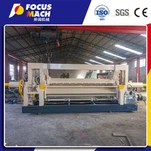
Finger jointing machines serve as critical equipment in the artificial board industry for plywood production, with their core technologies determining product quality and production efficiency. This article provides an in-depth analysis of the fundamental principles, main types, structural components, and selection criteria for finger jointing machines, offering comprehensive technical reference for industry professionals.
1. Basic Principles and Working Process of Finger Jointing Machines
The core technological principles of finger jointing machines are based on wood processing techniques and adhesive bonding technology, achieving the transformation of small-sized wood pieces into large-format panels through the combination of mechanical force and chemical adhesion.
1.1 Core Process Principles
The working principle of finger jointing machines can be summarized as four continuous processes: "adhesive application - assembly - pressing - curing." First, adhesive is evenly applied to the joining surfaces of the wood pieces. Then, the coated wood pieces are arranged according to a preset pattern (assembly). Next, mechanical pressure is applied to ensure tight contact between the joining surfaces. Finally, the adhesive is allowed to cure under maintained pressure to form strong joints.
Key scientific principles involved in this process include:
- Wood surface characteristics: The porous structure of wood affects adhesive penetration and bond strength
- Adhesive rheology: The viscosity and flow properties of the adhesive influence application uniformity
- Pressure distribution mechanics: Pressure uniformity determines adhesive layer thickness consistency
- Heat transfer principles: For adhesives requiring heat curing, temperature distribution affects curing quality
1.2 Typical Workflow
The standard workflow of modern automatic finger jointing machines includes the following steps:
- Feeding and positioning: Wood pieces to be joined are conveyed into the work area via a transport system, with positioning devices ensuring precise alignment
- Surface treatment: Some high-end equipment includes surface sanding or cleaning devices to improve bonding quality
- Adhesive application: The adhesive system applies adhesive evenly to the joining surfaces according to set parameters
- Assembly arrangement: Robotic arms or conveying devices arrange the coated wood pieces according to preset patterns
- Pressing and curing: The pressing system applies set pressure and maintains it until initial adhesive curing
- Discharge and conveying: Pressure is released, and the joined panels are sent to the next process
1.3 Key Process Parameter Controls
Achieving high-quality joints requires precise control of the following parameters:
- Adhesive application rate: Typically controlled at 120-200g/m², adjusted according to wood type and adhesive
- Pressing pressure: 0.5-1.2MPa for softwoods, 1.0-2.5MPa for hardwoods
- Pressing time: Related to adhesive curing characteristics, typically 1-3 minutes
- Environmental conditions: Optimal temperature 15-30°C, relative humidity 40-70%
2. Main Types of Finger Jointing Machines and Their Application Characteristics
Finger jointing machines can be classified into various types based on joining direction, automation level, and special functions, each with its applicable scenarios and technical features.
2.1 Classification by Joining Direction
2.1.1 Longitudinal Finger Jointing Machines
Equipment specifically designed for lengthwise joining of wood pieces, with main features including:
- Structural characteristics: Linear layout with conveying systems and pressing devices arranged along the length
- Technical advantages: Capable of producing extra-long panels (up to 12 meters or more)
- Typical applications: Flooring substrates, long panels for furniture
- Representative models: HOMAG KAL 310 series from Germany
2.1.2 Transverse Finger Jointing Machines
Designed specifically for widthwise joining, with features including:
- Structural characteristics: Wide-format design with transverse pressing devices
- Technical advantages: Can produce extra-wide panels (up to 2.5 meters)
- Typical applications: Table tops, door core panels and other wide-format products
- Representative models: Cefla UniLine series from Italy
2.2 Classification by Automation Level
2.2.1 Automatic Finger Jointing Machines
Highly automated modern finger jointing systems with technical features including:
- Core configurations: Automatic feeding systems, visual positioning, robotic assembly, intelligent control systems
- Production efficiency: Up to 20 meters/minute
- Precision control: Joint gap tolerance within ±0.1mm
- Representative manufacturers: Steiner (Switzerland), Yalian Machinery (China)
2.2.2 Manual Finger Jointing Machines
Simple equipment suitable for small-scale production, with features including:
- Structural characteristics: Primarily mechanical pressing, manual loading and assembly
- Cost advantages: Priced at only 1/5-1/3 of automatic equipment
- Application scenarios: Custom furniture factories, small wood product workshops
- Typical models: MB series from Zhenxiao Machinery (Taiwan)
2.3 Special Function Types
2.3.1 Curved Finger Jointing Machines
Specialized equipment capable of irregular shape joining:
- Core technology: CNC bending and positioning systems
- Special structures: Flexible pressure belts or multiple independent pressing units
- Application fields: Bentwood furniture, musical instrument manufacturing
2.3.2 High-Frequency Finger Jointing Machines
Advanced equipment using high-frequency heating to accelerate curing:
- Heating method: High-frequency electric field causes molecular friction heating
- Curing speed: 5-10 times faster than conventional heating
- Energy characteristics: High instantaneous power but low total energy consumption
- Representative manufacturers: Bürkle (Germany), Meinan (Japan)
3. Structural Components and Key Technologies of Finger Jointing Machines
Modern finger jointing machines are complex systems integrating mechanical, electrical, hydraulic and pneumatic technologies, with subsystems working in coordination to ensure joining quality.
3.1 Key Technologies of Adhesive Application Systems
3.1.1 Roller Adhesive Application Systems
The most commonly used adhesive application method, consisting of:
- Adhesive supply system: Adhesive pumps, storage tanks, filters, flow control valves
- Application mechanism: Adhesive rollers, doctor blades, gap adjustment devices
- Recovery system: Excess adhesive collection and recycling
Key technical points:
- Roller surface material (typically stainless steel or special rubber)
- Roller pressure control accuracy (±0.02mm)
- Adhesive temperature control system (maintaining viscosity stability)
3.1.2 Spray Adhesive Systems
Suitable for high-viscosity adhesives or special processes:
- Atomization methods: Air atomization, airless atomization, or hybrid
- Control points: Spray pattern, particle size distribution, coverage uniformity
- Advantages: Adhesive savings (15-30% reduction possible)
3.1.3 Adhesive Quantity Control Systems
Core subsystems of modern finger jointing machines:
- Measurement methods: Mass flow meters or volumetric metering pumps
- Feedback control: Dynamic adjustment based on online viscosity detection
- Advanced technology: Vision systems for adhesive line quality inspection
3.2 Design Essentials of Pressing Systems
3.2.1 Hydraulic Pressing Systems
Standard configuration for medium and large finger jointing machines:
- Components: Hydraulic power units, cylinders, control valve blocks, pressure sensors
- Performance parameters: Maximum working pressure 25MPa, pressure fluctuation <±0.05MPa
- Advanced technology: Proportional valve control for gradual pressure application
3.2.2 Pneumatic Pressing Systems
Suitable for light-duty joining requirements:
- System characteristics: Fast response, simple maintenance
- Pressure range: 0.4-0.8MPa
- Typical applications: Veneer joining, thin panel production
3.2.3 Pressure Distribution Optimization Technology
Key to ensuring joining quality:
- Even pressure design: Multiple synchronized cylinders or airbag pressing
- Monitoring methods: Pressure distribution sensor matrices
- Compensation technology: Automatic leveling systems
3.3 Conveying and Positioning Systems
3.3.1 Feeding Conveyor Systems
- Conveying methods: Belt conveyors, roller conveyors or chain conveyors
- Speed control: Variable frequency drive, synchronized with adhesive application
- Special designs: Anti-slip surfaces, vacuum adsorption fixation
3.3.2 High-Precision Positioning Technology
- Mechanical positioning: Adjustable stops, side clamping devices
- Optical positioning: CCD vision systems (accuracy ±0.05mm)
- Advanced systems: Laser scanning + servo correction
3.4 Architecture of Intelligent Control Systems
The "brain" of modern finger jointing machines:
- Hardware composition: Industrial PC + PLC + fieldbus
- Software functions: Recipe management, process parameter optimization, fault diagnosis
- HMI: Touchscreen operation, 3D simulation display
- Data interfaces: MES system integration support
4. Technical and Economic Considerations for Finger Jointing Machine Selection
Selecting appropriate finger jointing machines requires comprehensive consideration of technical parameters, production needs and investment returns.
4.1 Production Scale and Automation Matching
4.1.1 High-Volume Production Configuration
- Equipment type: Fully automated inline systems
- Recommended configuration:
Automatic feeding systems
Robotic assembly units
Online quality inspection
- ROI: 2-3 year payback for annual production over 50,000 m³
4.1.2 Medium/Small Batch Production Configuration
- Equipment type: Semi-automatic standalone machines
- Economic solutions:
Manual feeding + automatic adhesive application
Simple pressing systems
Basic control functions
- Application scenarios: Flexible production of multiple varieties in small batches
4.2 Product Specifications and Equipment Parameters
4.2.1 Length Specification Matching
- Standard products: 6-8 meter models
- Extra-long requirements: Consider 12 meter models or custom solutions
- Technical note: Long equipment requires attention to bed straightness (≤0.1mm/m)
4.2.2 Width Specification Matching
- Standard selection: 1.3-1.8 meter working width
- Wide-format needs: Special pressing system design for over 2 meters
- Economic consideration: Nonlinear price increase for extra-wide equipment
4.3 Adhesive Compatibility Considerations
4.3.1 PVAc Adhesive-Specific Equipment
- System characteristics:
Room temperature curing
Open time 5-15 minutes
No heating system required
- Cost advantages: Simple equipment, low investment
4.3.2 UF/PF Adhesive Equipment
- Special requirements:
Heating and pressing systems (100-120°C)
Corrosion-resistant adhesive application components
Exhaust gas collection devices
- Production benefits: Fast curing (1-2 minutes), suitable for continuous production
4.4 Energy Efficiency and Environmental Assessment
4.4.1 Energy Consumption Comparison
- Hydraulic systems: Installed power 15-75kW, actual consumption about 60%
- Pneumatic systems: Requires air compressors, relatively low overall efficiency
- Electric servo: Emerging technology, high efficiency but higher initial cost
4.4.2 Environmental Performance Indicators
- Adhesive mist collection: Enclosed application chamber + filtration systems
- Noise control: Optimal below 75dB(A)
- Material safety: Compliance with RoHS standards
4.5 Key Points for Supplier Evaluation
4.5.1 Technical Capability Assessment
- R&D capability: Number of patents, technical team background
- Manufacturing capability: Machining equipment precision (e.g., planer mill accuracy)
- Case studies: On-site inspection of similar products in operation
4.5.2 Service Support Systems
- Response time: Preferably on-site service within 24 hours
- Spare parts inventory: Local supply of common spare parts
- Training programs: Systematic operation and maintenance training
4.5.3 Comprehensive Cost Analysis
- Initial investment: Equipment price (approximately ¥1-5 million for automatic lines)
- Operating costs: Comprehensive calculation of adhesive consumption, energy use, labor
- Maintenance costs: Annual maintenance budget (typically 2-3% of equipment price)
Through detailed analysis of these four aspects, users can fully understand the technical characteristics of finger jointing machines and select appropriate equipment models and configurations based on their production needs, achieving optimal investment returns. With the development of smart manufacturing technologies, finger jointing machines continue to evolve toward smarter, more efficient and more environmentally friendly solutions, providing the plywood industry with more advanced processing technologies.