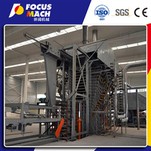
In the modern wood processing industry, automation and intelligence have become key to enhancing competitiveness. The automatic log cutting saw (also known as an automatic log breaker or CNC cross-cut saw), as a core piece of equipment at the front end of the production line, plays an irreplaceable role. This article provides a comprehensive introduction to the technical features and application value of this equipment.

I. Equipment Introduction: Farewell to Tradition, Entering the CNC Era
An automatic log cutting saw is an intelligent mechanical equipment integrated and controlled by a Computer Numerical Control (CNC) system. It automates the processes of log feeding, precise positioning, clamping, high-speed cutting, and sorted discharge. It has completely revolutionized the traditional mode of operation that relied on manual measurement and handling, achieving tremendous leaps in efficiency, precision, and safety.
II. Core Components: Five Systems Working in Sync
An efficient automatic log saw is like a cohesive unit working in concert, composed of the following five systems:
- Feeding System: Acts as the "transport team," typically using roller or chain conveyors to smoothly feed logs into the processing area.
- Positioning and Clamping System: Serves as the "surveyor" and "clamp." It integrates functions like encoder length measurement and metal detection to prevent damage, and uses hydraulic/pneumatic press beams to ensure the log remains completely stationary during cutting.
- Cutting System: The "heart" of the equipment. It consists of a high-power motor driving a high-strength alloy saw blade (circular or band saw) to perform the final cutting task.
- CNC Control System: The "brain" of the equipment. It receives instructions and controls all operations, possessing intelligent functions such as optimization calculations, data storage, and fault diagnosis.
- Discharge System: Acts as the "sorter," automatically conveying the cut wood segments to the next process stage, enabling continuous production.
III. Core Advantages: Why Choose Automatic Cutting?
- Ultimate Precision: The CNC system ensures minimal length error for each wood segment (within ±1mm), providing high-quality blanks for subsequent processing.
- Exceptional Efficiency: Automated cyclic operation allows for cutting speeds of several cycles per minute or more, increasing productivity by 5-10 times compared to manual labor, significantly boosting output capacity.
- Excellent Economy: The built-in "optimization calculation" function intelligently computes the cutting plan with the highest yield rate based on order requirements, maximizing material savings and reducing costs.
- Inherent Safety: Multiple safety designs, including fully enclosed guards, safety light curtains, anti-kickback devices, etc., greatly prevent direct contact between personnel and the saw blade, ensuring operational safety.
- Reduced Labor Intensity: Operators only need to input parameters, freeing them from heavy physical labor, allowing one person to monitor multiple machines.
IV. Wide Range of Applications
This equipment is a "powerful assistant" in various wood processing scenarios:
- Solid Wood Furniture Manufacturing: Cutting standard-length rough blanks for furniture components.
- Wooden Pallet & Packaging Box Industry: Efficiently producing pallet blocks and lumber for crates/boxes.
- Construction Lumber Processing: Precisely cutting lumber used for structural support.
- Panel Industry: Preparing logs of specified length for veneer peeling mills or particleboard plants.
- Musical Instrument & Craft Production: Cutting specific blanks requiring high quality and precision.