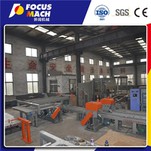
LVL is a very stable and straight wood product, made from wooden boards. All veneer boards stripped from wood veneer peeler LVL plywood are laid so that the grain orientation is the same in all veneers. The LVL process is based on a combination of a layup and a cyclic heat press. It is made by gluing together multiple layers of thin wood veneers using an adhesive to create a strong, durable and even product that can be used in a variety of applications, including floors, roofs and walls.
These laminated finishing woods offer several advantages over conventional woods. First, it is structurally stronger than solid wood. This is because the product is layered by layering a thin veneer that scatters wood grain in different directions. This process results in a stronger product that is less likely to twist, twist or split under pressure. Second, its strength and quality are more consistent than conventional wood. This is because each veneer that makes up the LVL board is carefully selected to ensure that it meets strict quality standards. In addition, the manufacturing process of LVL products is highly controlled, which ensures uniform quality for each plate.
Another benefit of using LVL is that it is more environmentally friendly than conventional wood. That's because these laminated veneer woods are made from fast-growing, sustainably harvested trees, rather than older trees that take decades to regenerate. In addition, the manufacturing process of laminated veneer wood consumes less energy and wastes less than the process of producing conventional wood.
Laminated veneer wood is also resistant to shrinkage and warping, which means it retains its shape even in wet conditions. This makes it ideal for use in areas with humidity or moisture, such as bathrooms and basements.
One of the most common applications of LVL is in the construction of beams and headers. Beams and headers are essential structural components in buildings that support structural weight and transfer it to the foundation. Use LVL beams and headers instead of traditional solid wood beams and headers because they are stronger, more uniform in strength, and less likely to twist, twist, or split.
These laminated veneers can also be used as flooring materials. It is commonly used as a sub-slab in houses built on raised foundations. The pedestal is the layer that sits on top of the foundation and serves as the foundation for finishing the floor. Compared to conventional sublines made of solid wood, LVL submeters are robust, durable and less likely to sag or warp over time.
It is also commonly used as a roof deck material. A roof deck is a deck layer located on top of a roof truss or joist. LVL roof decks are strong, stable and even, which is ideal for use on steep roofs. In addition, it can be manufactured in longer lengths than conventional wood, which means that fewer planks are required, providing a more efficient and cost-effective solution.